Ewing
The Long WalkEwing, identified throughout the Long Walk as Walker 9, is remembered chiefly through the progressive destruction of his body and the abruptness of his elimination. His death comes early enough to establish the contest’s governing cruelty: a participant can possess conspicuous strength, endurance, and the support of nearby walkers, yet still be reduced to a warning record and a gunshot when his body can no longer maintain the required pace.
Identity and Introduction
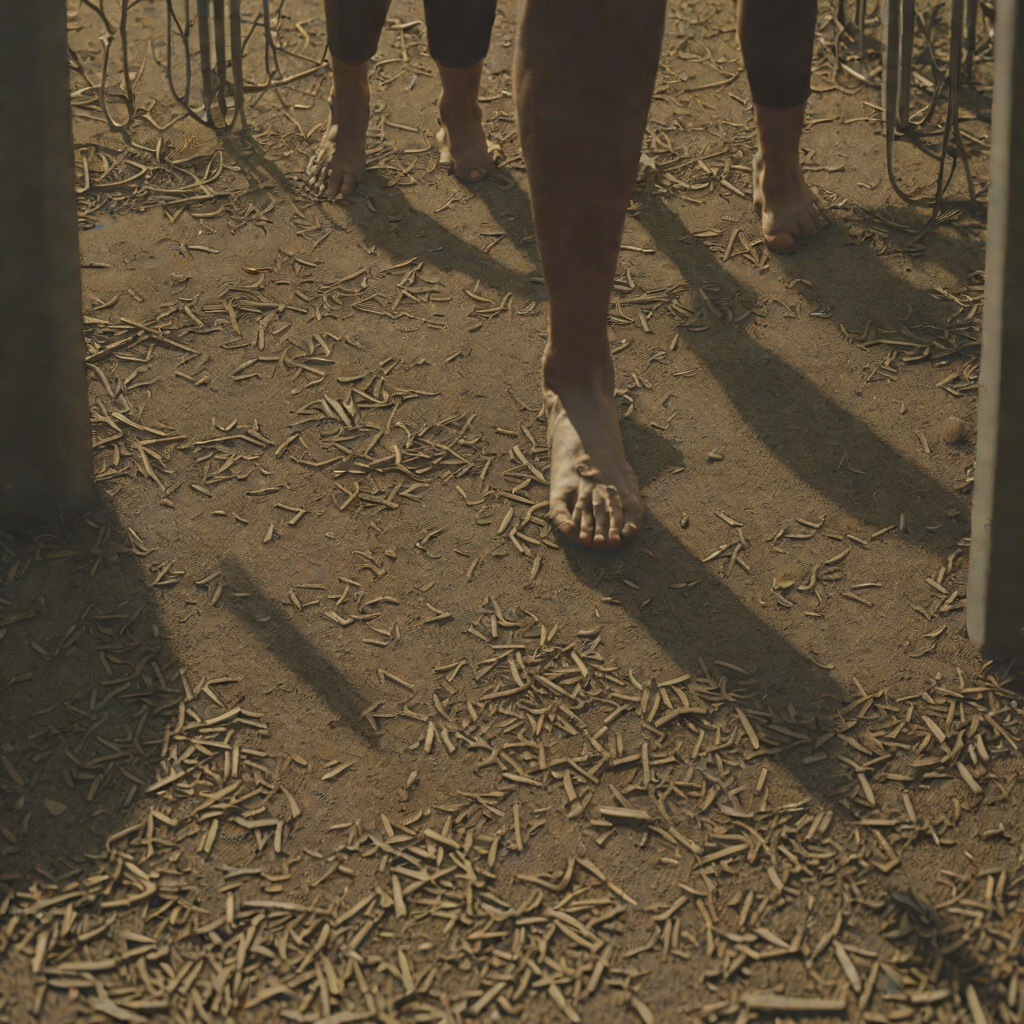
Ewing is a Black Walker from Texas who had ridden to the event with the other contestants. His physical presence initially makes him appear well equipped for endurance. When Arthur Baker reports that Ewing is blistering badly, he emphasizes the contrast between Ewing’s powerful musculature and the damage being done to his feet: Ewing is said to be walking in the pus of broken blisters, with muscles that seem capable of lasting for days but cannot protect him from blisters and charley horses.
His identity is also filtered through the social hostility of the Walk. Gary Barkovitch responds to the report of Ewing’s blisters with a racist insult, treating the injury as proof of supposed racial or personal inferiority rather than as a consequence of the contest’s conditions. Arthur Baker answers evenly but directly, ordering Gary Barkovitch to move away and threatening to poke him. Gary Barkovitch retreats while preserving the antagonistic tone, and the exchange leaves behind the image of a small poisonous atmosphere surrounding Ewing as he struggles forward.
Physical Breakdown and Warnings
Ewing’s crisis spreads through the Walk by rumor before it becomes fully visible. The grapevine reports that he has developed blisters and has already received two warnings, while many other Walkers have also been warned as part of the ordinary operation of the contest. The distinction is that Ewing’s situation looks terminal. Arthur Baker accelerates to walk beside him and speaks with him for some time, then deliberately drops back to avoid receiving a warning himself. Baker’s conduct shows both solidarity and the limits imposed on solidarity: he can accompany Ewing briefly, but cannot risk allowing another person’s failing pace to become his own.
The official warning follows immediately. The soldiers announce that Ewing has received his third warning, placing him under the contest’s established penalty system. His back, visibly soaked with sweat until the white shirt has turned gray down the middle, and the large muscles moving beneath it make his suffering legible to the spectators and the other Walkers. The scene refuses the comforting idea that strength is a reliable defense. Ewing’s body is not lacking power; it is being defeated by a small, cumulative injury that the event treats as sufficient grounds for death.
Elimination and Death
Ewing attempts to remain within a group of boys, perhaps hoping that their presence will shield him or at least prevent him from becoming isolated. The soldiers push the other Walkers aside and drag him toward the shoulder, removing the temporary human cover that surrounds him. He tries to fight, but only weakly. One soldier pins his arms behind him while another raises a carbine to his head and shoots. One of Ewing’s legs kicks convulsively after the shot, a final involuntary movement that contrasts with the controlled procedure of the execution.
The death is presented as both routine and morally jarring. Peter McVries breaks the stillness by observing that Ewing bleeds the same color as anyone else, rejecting the dehumanizing logic that had just been voiced against him. Yet the narrative immediately converts Ewing into a numerical remainder: two Walkers are now gone, and the odds have shifted infinitesimally in favor of those still alive. The contrast between McVries’s insistence on shared humanity and the arithmetic of the Long Walk defines Ewing’s afterlife within the event. His individual death matters emotionally, but the institution records it as a changed count.
Consequences for the Walkers
Ewing’s death follows the earlier execution of Curley, whose head is destroyed by four carbine shots after he can no longer keep pace. The two deaths teach the same lesson in different forms. Curley’s killing occurs in full view of a crowd that suddenly understands that the Walkers really can be shot; Ewing’s is more controlled and intimate, but no less final. Together they transform the warnings from an abstract rule into a visible sequence of bodily consequences.
The deaths also sharpen the surviving Walkers’ uneasy relation to one another. They listen, calculate, and wonder what happens to the bodies, while the reduction in numbers offers a mathematically favorable development. Later, the Long Walk’s arithmetic continues to intrude on personal identity: at roughly eighty miles, Peter McVries tells Ray Garraty that twenty-seven Walkers are already gone and that they are a quarter of the way home; after ninety-nine miles, Ray Garraty notes that thirty-six have fallen. Ewing’s death is therefore not an isolated tragedy but one of the first entries in the contest’s expanding body count.
Narrative Significance
Ewing’s elimination demonstrates that the Long Walk’s violence is carried out through a system that combines surveillance, warnings, public attention, and authorized execution. The soldiers do not need to debate whether Ewing deserves punishment. Once the warning threshold is reached, his damaged body becomes administratively legible as a ticket, and the procedure proceeds even while the surrounding boys remain close enough to witness it.
For the surviving Walkers, Ewing’s death weakens the boundary between athletic competition and state violence. The event promises a prize and measures progress in miles, but its decisive instrument is not victory in any ordinary sporting sense; it is the power to declare a body too slow and then kill it. Ewing’s strong back, infected feet, attempted resistance, and convulsively kicking leg make that principle concrete. He is remembered not through a completed personal ambition, but through the moment when a living, suffering person is translated into Walker 9, a third warning, and one fewer competitor.